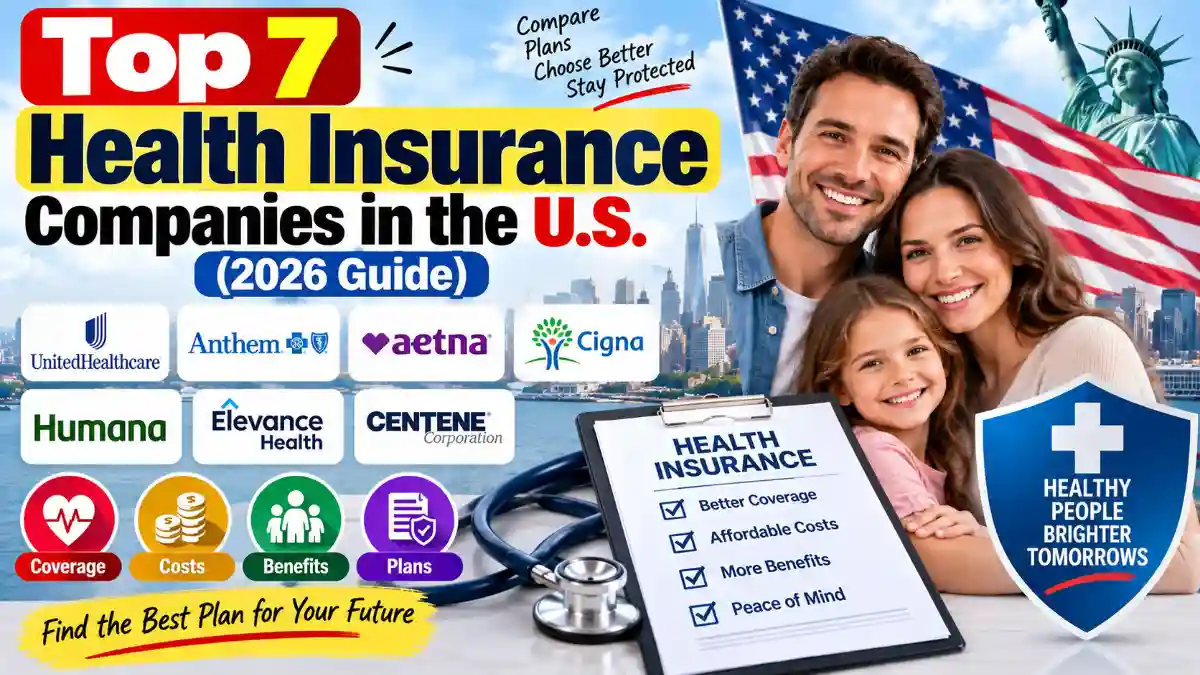
Choosing a health insurance company is one of the biggest financial decisions a household makes each year. With dozens of carriers competing for your business, the differences between them go far beyond monthly premiums — network size, customer service, digital tools, and financial stability all shape whether a plan actually works for you when you need care.
Below is a practical breakdown of the seven health insurance companies that consistently rank among the largest and most trusted in the country, along with what makes each one stand out, where it falls short, and who it tends to suit best.
How We Picked These Companies
Rather than relying on marketing claims, this list weighs four factors that matter most to real policyholders:
- Market share and scale — a rough proxy for network size and negotiating power with hospitals
- Customer satisfaction data — drawn from industry surveys that track claims handling and service quality
- Financial strength — an insurer’s ability to pay claims reliably over the long term
- Plan variety and availability — whether the company offers marketplace, employer, Medicare, and Medicaid options across the country
With that framework in mind, here are the seven carriers worth knowing.
1. UnitedHealthcare
UnitedHealthcare, the insurance arm of UnitedHealth Group, is the largest health insurer in the country by a wide margin, holding roughly 15–16% of the national market and generating well over $200 billion in annual premiums. It operates in all 50 states and Washington, D.C., offering employer plans, individual marketplace coverage, Medicare Advantage, and Medicaid managed care.
Strengths: Unmatched network breadth, strong financial ratings, and one of the widest selections of plan types for individuals, families, and employers alike.
Watch out for: UnitedHealthcare has slipped in several 2026 customer satisfaction rankings, and it has scaled back Medicare Advantage offerings in some counties. If you prioritize service quality over sheer size, it’s worth comparing against smaller regional carriers before signing up.
Best for: People who want the largest possible provider network and plan variety, especially self-employed buyers shopping the marketplace.
2. Elevance Health (Anthem)
Formerly known as Anthem, Elevance Health is the second-largest insurer by enrollment and controls close to 9–12% of the market depending on how it’s measured. It operates under the Blue Cross Blue Shield name in states including California, Ohio, New York, Georgia, and Virginia.
Strengths: Elevance combines large-scale resources with the local trust that Blue Cross branding carries in many states. It also invests heavily in behavioral health and whole-person care programs.
Watch out for: Coverage isn’t available nationwide under the Elevance/Anthem brand — it operates in a specific set of states, so availability depends heavily on where you live.
Best for: Residents of Elevance’s core states who want a large insurer with strong regional brand recognition.
3. Aetna (CVS Health)
Aetna, now part of CVS Health, insures more than 36 million members and holds a significant share of both the employer and individual markets. Its integration with CVS pharmacies and MinuteClinic locations gives it a distinctive edge in coordinating everyday care with insurance coverage.
Strengths: Excellent financial strength ratings, nationwide availability, and tight integration with CVS’s retail pharmacy and clinic network, which can simplify prescriptions and minor-care visits.
Watch out for: As with most large national carriers, customer satisfaction scores are middling — solid but not standout compared to smaller regional plans.
Best for: People who already use CVS pharmacies regularly and want their insurance and pharmacy benefits working together.
4. Cigna
Cigna operates in all 50 states and is particularly well known for its strong international and expat coverage, along with a growing suite of virtual care and telehealth options. It holds around 10–11% of the national market.
Strengths: Cigna consistently scores above the industry average for digital satisfaction, meaning its app, telehealth tools, and online account management tend to be smoother than competitors’.
Watch out for: Plan availability and network quality can vary noticeably by region, so it pays to check local provider directories before enrolling.
Best for: Frequent travelers, expats, and anyone who wants a strong digital and virtual-care experience.
5. Blue Cross Blue Shield (BCBS)
Blue Cross Blue Shield isn’t a single company but a federation of 36 independent, locally operated companies that together cover people in all 50 states. This structure gives BCBS an unusual mix of national reach and local, community-based operation.
Strengths: Because each BCBS company is run independently, plans are often tailored closely to local hospital networks and regional health needs. Combined, the BCBS system covers more Americans than any single-branded competitor.
Watch out for: Quality and pricing can differ substantially from state to state, since you’re really choosing a specific regional BCBS company rather than one uniform national insurer.
Best for: People who want strong, well-established local networks backed by a nationally recognized brand.
6. Kaiser Permanente
Kaiser Permanente takes a different approach than the rest of this list: it’s an integrated managed care system, meaning the insurance company and the hospitals/doctors are part of the same organization. It’s available in a more limited set of states — including California, Colorado, Georgia, Hawaii, Maryland, Oregon, Virginia, and Washington, D.C. — but it has topped customer satisfaction rankings for several years running.
Strengths: Because Kaiser controls both the insurance and the care delivery side, it tends to produce lower deductibles, simpler billing, coordinated electronic health records, and consistently high marks for customer service.
Watch out for: Its integrated model means you’re generally limited to Kaiser’s own doctors and facilities, which won’t suit people who want an open-choice PPO or who live outside its service areas.
Best for: People living in a Kaiser service area who value coordinated care and top-tier customer satisfaction over network flexibility.
7. Humana
Humana has built its reputation primarily around Medicare Advantage, where it’s one of the two largest players in the country alongside UnitedHealthcare. It has also been one of the few major insurers to grow its Medicare Advantage enrollment even as industry-wide growth has slowed.
Strengths: Deep specialization in senior-focused coverage, including wellness programs, dental/vision add-ons bundled into many plans, and care coordination features designed around chronic condition management.
Watch out for: Humana’s individual and employer-sponsored offerings are far less extensive than its Medicare business, so it’s a stronger fit for retirees than for younger individuals or families shopping the general marketplace.
Best for: Medicare-eligible individuals looking for a Medicare Advantage plan with strong extra benefits.
How to Choose Between Them
With so many strong options, the “best” health insurance company really depends on your specific situation. A few questions can help narrow it down:
- Where do you live? Availability varies significantly — Kaiser and Elevance, for example, only operate in specific states, while UnitedHealthcare, Aetna, Cigna, and BCBS have a nationwide presence.
- Do your preferred doctors and hospitals accept the plan? Always check a carrier’s provider directory before enrolling, since even large national insurers can have gaps in certain regions.
- Are you shopping for Medicare? If so, compare Medicare Advantage-focused insurers like Humana and UnitedHealthcare closely, since their extra benefits and star ratings differ from their general marketplace offerings.
- How much do you value digital tools versus in-person service? Cigna and Kaiser tend to score well on digital and overall satisfaction, while others compete primarily on price and network size.
- What’s your risk tolerance on premiums versus out-of-pocket costs? Larger insurers often offer more plan tiers, letting you trade a higher premium for a lower deductible or vice versa.
Conclusion
There’s no single “best” health insurance company for everyone — the right choice depends on where you live, which doctors you want to keep, and whether you’re shopping for individual, employer, or Medicare coverage. UnitedHealthcare, Elevance Health, Aetna, and Cigna offer the broadest reach and plan variety, Blue Cross Blue Shield brings strong regional networks under a trusted national brand, Kaiser Permanente delivers consistently high satisfaction through its integrated care model, and Humana stands out for Medicare Advantage shoppers.
Before enrolling, take the time to compare quotes side by side, confirm your doctors are in-network, and read the fine print on deductibles and out-of-pocket maximums. A little research upfront can save you thousands of dollars — and a lot of frustration — over the life of your policy.